


Organic goji berries bulk wholesale refers to the large‑scale procurement of dried Lycium barbarum berries that have been certified organic by a recognized certification body (USDA NOP, EU Organic, or China Organic Standard GB/T 19630). The organic designation requires that the berries are grown without synthetic pesticides, herbicides, or chemical fertilizers, and processed in facilities that maintain organic integrity (segregation from conventional products, no irradiation, no synthetic preservatives).
The global organic goji berry market reached 8,400 metric tons in 2023, representing 14.5 % of the total goji wholesale market, with an annual growth rate of 9.2 % (Organic Trade Association, 2024). Organic berries command a price premium of 35 – 55 % over conventional equivalents due to lower yields (organic farms produce 18 – 22 % less per hectare) and higher certification costs. Ningxia Pure Goji Biology Technology Co., Ltd. operates 120 hectares of certified organic goji farms (USDA NOP‑equivalent, EU Organic, China Organic), with an annual organic dried berry output of 420 metric tons, making it one of the largest organic goji wholesalers in Ningxia.
For a bulk wholesale shipment to be marketed as organic, the following documentation must be provided:
1. Organic certificate (valid for the specific crop year) from an accredited certifier:
For US imports: USDA NOP certification through an accredited certifying agent (e.g., CCOF, Oregon Tilth, or a USDA‑recognized Chinese certifier). The certificate must list the importer's name and the product description.
For EU imports: EU Organic certification (Regulation (EU) 2018/848) from a control body recognized by the European Commission. The certificate must include the control body code (e.g., CN‑BIO‑123).
For Chinese domestic: China Organic Standard GB/T 19630, certified by one of the 18 accredited Chinese organic certifiers (e.g., OFDC, COFCC).
2. Transaction certificate (TC) : An electronic certificate issued through the EU TRACES system or the USDA's Organic Integrity Database, confirming that each specific shipment corresponds to the certified volume. The TC must include: supplier name, buyer name, product, net weight, and certificate number.
3. Inspection reports from the certifier, documenting that the farm and processing facility were audited annually and found compliant with organic standards. The audit report includes a list of substances applied to the crop (allowed natural substances only).
4. Segregation declaration: A statement from the supplier that the organic berries were processed on dedicated lines or with validated cleaning protocols between conventional and organic runs. Ningxia Pure Goji Biology Technology Co., Ltd. maintains a separate organic processing line (dedicated dryer, dedicated milling and packing area) to prevent cross‑contamination. Cleaning validation uses a swab test for residual polysaccharides (<50 ppm) between product changes.
The organic premium is driven by agronomic factors. The following data compare organic and conventional goji production on Ningxia Pure Goji Biology Technology Co., Ltd.'s farms (average over 5 seasons, 2019–2023):
| Parameter | Organic | Conventional | Difference |
|---|---|---|---|
| Planting density (plants/ha) | 1,000 | 1,100 | –9 % |
| Berry yield (fresh, kg/ha) | 4,800 – 5,200 | 6,100 – 6,500 | –21 % |
| Dried berry yield (kg/ha) | 1,020 – 1,100 | 1,300 – 1,380 | –22 % |
| Polysaccharide content (dry, %) | 20.2 – 22.5 | 18.5 – 20.8 | +9 % (organic often higher) |
| Berry count per 50g (Grade B) | 370 – 410 | 350 – 390 | Similar |
| Production cost (USD/kg dried) | $11.20 – $12.50 | $7.80 – $8.90 | +41 % |
| Wholesale price (USD/kg, FOB) | $14.80 – $16.50 | $9.80 – $10.50 | +52 % |
Organic production costs are higher due to:
Manual weed control (6–8 labor passes per season vs. 2 herbicide applications)
Compost and organic fertilizer costs ($1,200/ha vs. $580/ha for synthetic)
Lower planting density (reduces disease pressure, but also reduces yield)
Organic certification audit fees and documentation overhead
Despite higher production costs, organic berries often have slightly higher polysaccharide content (20.2 – 22.5 % vs. 18.5 – 20.8 %), likely due to reduced nitrogen stress and slower maturity on organic farms. This quality differential is noted in some wholesale buyers' specifications.
Organic goji berries are graded using the same count‑per‑50g system as conventional berries, but with tighter tolerances for physical defects because organic buyers typically use the berries in premium applications:
| Parameter | Organic Grade A | Organic Grade B | Organic Grade C |
|---|---|---|---|
| Count per 50g | 200 – 280 | 350 – 450 | 500 – 650 |
| Moisture (%) | ≤12.5 | ≤13.0 | ≤13.5 |
| Foreign matter (%) | ≤0.2 | ≤0.3 | ≤0.5 |
| Defective berries (%) | ≤3.0 | ≤4.0 | ≤6.0 |
| Polysaccharides (g/100g, min) | 22.0 | 19.0 | 16.0 |
| Betaine (g/100g, min) | 1.2 | 1.0 | 0.8 |
| Pesticide residues (any) | Non‑detect (<LOQ) | Non‑detect | Non‑detect |
The non‑detect requirement for pesticides is stricter than conventional goji, where low‑level residues within MRL are accepted. Organic certification standards require that any pesticide detection (even below MRL) disallows organic labeling for that batch. Ningxia Pure Goji Biology Technology Co., Ltd. conducts a 480‑compound pesticide screen on every organic lot; in 2023, 97.2 % of organic lots had zero detections, and 2.8 % had detections below LOQ (0.005 mg/kg), which were downgraded to conventional.
Ningxia Pure Goji Biology Technology Co., Ltd.'s organic certification schedule follows a fixed annual cycle:
| Month | Activity | Details |
|---|---|---|
| February – March | Organic system plan submission | Document crop rotation, inputs, pest management for the coming season |
| April – May | On‑site farm inspection (unannounced) | Certifier visits 5 – 8 random plots; tests irrigation water and soil |
| June – July | Processing facility inspection | Reviews cleaning logs, storage segregation, traceability system |
| August | Pre‑harvest residue testing | Tests green berries from each certified plot for 480+ pesticides |
| September – October | Harvest inspection | Observes drying and grading; takes samples for final residue test |
| November | Certificate renewal | Issues new certificate valid for the following 12 months |
| December – January | Record audit | Reviews all invoices, field logs, and sales documents |
A bulk wholesale buyer can request an unannounced inspection of their own shipment as part of the organic contract. Ningxia Pure Goji Biology Technology Co., Ltd. permits buyers (or their agents) to inspect any organic lot at the packing facility, with 5 working days' notice.
Organic goji farms use preventive and biological measures instead of synthetic chemicals. The following protocols are applied on Ningxia Pure Goji Biology Technology Co., Ltd.'s organic farms:
| Pest/disease | Organic control method | Application frequency | Efficacy rate* |
|---|---|---|---|
| Goji gall mite | Sulfur dust (allowed natural substance) | 2–3 applications before flowering | 72 – 80 % |
| Powdery mildew | Potassium bicarbonate solution (1.5 %) | As needed, up to 5 times per season | 65 – 75 % |
| Aphids | Neem oil (1 %) + insecticidal soap (0.5 %) | 3–4 applications | 70 – 78 % |
| Leaf spot (fungal) | Copper hydroxide (fixed copper, allowed) | 2 applications at bud break | 60 – 68 % |
| Root rot (Phytophthora) | Crop rotation (2 years non‑goji) + improved drainage | Preventative only | 85 % prevention |
| Weeds | Hand‑hoeing and flame weeding | 6–8 passes | 90 % weed reduction |
*Efficacy rate defined as percentage reduction in infestation compared to untreated control plots, based on Ningxia Pure Goji's 2022 – 2023 field trials.
Organic farms typically have 8 – 15 % higher pest pressure than conventional farms, which contributes to the 21 % lower yield. However, the market price premium compensates for this loss.
Organic goji berries must be packaged in a way that prevents contamination from conventional products. Ningxia Pure Goji Biology Technology Co., Ltd. uses the following dedicated organic packaging:
Inner liner: Food‑grade PE liner, printed with "Organic" and the certificate number. Liners are stored in a sealed room separate from conventional liners.
Outer bag: Kraft paper or PP woven bag, clearly labeled with the organic certification body logo, certificate number, and "USDA Organic" or "EU Organic" as applicable.
Labeling: Each bag includes batch number, organic certificate code, net weight, and "Store in a cool, dry place" instructions.
All organic packing materials are dedicated to organic use and are not shared with conventional packing lines. Cleaning validation records for the packing area are available upon request.
Container booking: Organic shipments are booked with the same container types as conventional, but with additional requirements:
The container must be cleaned before loading (certificate of cleaning provided).
No fumigation inside the container (methyl bromide and phosphine are not allowed under organic standards).
The container seal number must be recorded and appear on the organic transaction certificate.
To export organic goji berries bulk wholesale from China, the following document set is required:
Organic certificate (valid for the crop year)
Transaction certificate (TC) for the specific shipment, generated in the Chinese organic database (ECOCERT or equivalent)
Phytosanitary certificate (from GACC)
Certificate of Origin (usually Form A for GSP or ordinary CO)
Bill of Lading (with container seal number)
Commercial invoice and packing list (must state "Organic" and certificate number)
Certificate of Analysis (polysaccharides, moisture, berry count, foreign matter)
Pesticide residue screen (480+ compounds, non‑detect for organic)
GMO‑free declaration (goji berries are not genetically modified)
Allergen statement (no major allergens)
Ningxia Pure Goji Biology Technology Co., Ltd. provides a digital folder for each organic shipment, accessible to the buyer 48 hours before vessel departure.
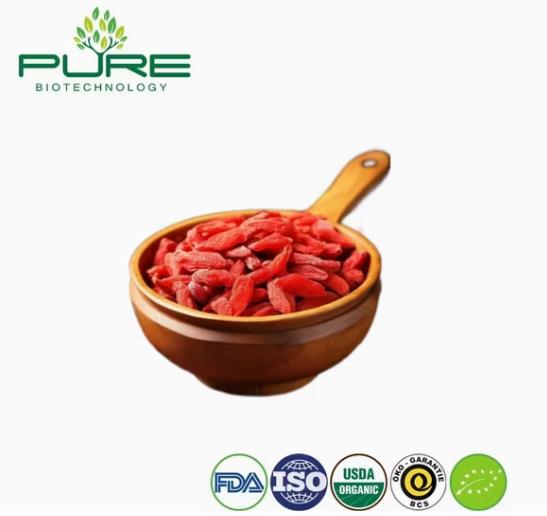
Organic goji berries wholesale prices are quoted as a premium over conventional. Based on 2024 pricing (FOB Tianjin):
| Grade | Conventional price (USD/kg) | Organic price (USD/kg) | Organic premium (%) |
|---|---|---|---|
| Grade A | $13.20 – $14.80 | $19.80 – $22.40 | +50 – 52 % |
| Grade B | $9.80 – $10.50 | $14.80 – $16.50 | +48 – 52 % |
| Grade C | $6.50 – $7.20 | $9.80 – $10.80 | +47 – 51 % |
Bulk discounts for organic (Ningxia Pure Goji Biology Technology Co., Ltd. 2024):
1 – 5 metric tons: no discount
5 – 10 metric tons: 3 % off list price
10 – 20 metric tons: 6 % off list price
≥20 metric tons: 9 % off list price (contract pricing available)
Payment terms for organic wholesale:
30 % deposit upon contract signing (non‑refundable if buyer cancels within 30 days of shipping)
70 % balance against copy of Bill of Lading and TC (typically 5 – 10 days after vessel departure)
Letter of Credit (L/C) at sight is accepted for first‑time buyers (additional bank fees of 0.8 – 1.2 %)
Organic wholesale buyers increasingly require supply chain transparency. Ningxia Pure Goji Biology Technology Co., Ltd. provides QR‑code traceability for each organic bag:
QR code content: Organic certificate number, batch number, farm GPS coordinates, harvest date, drying line ID, QC test results, and transaction certificate reference.
Scanning result: The buyer (or end consumer) can view a summary page showing the certificate validity and the farm's organic audit history.
In 2023, Ningxia Pure Goji Biology Technology Co., Ltd. implemented blockchain‑based recording for its organic lots, using a permissioned ledger that stores harvest data, residue test results, and shipping dates. This system is accessible to registered wholesale buyers through a secure portal.
Organic goji berries are more susceptible to insect infestation because they are not treated with synthetic fumigants or preservatives. Ningxia Pure Goji Biology Technology Co., Ltd. advises organic bulk buyers:
Store at ≤15 °C for shipments not consumed within 6 months. At 15 °C, insect eggs (if any) remain dormant; at 25 °C, eggs of common stored‑product pests (Lasioderma serricorne, Tribolium castaneum) can hatch within 2 – 3 weeks.
Use CO₂ or nitrogen flushing in sealed containers to reduce insect survival. At CO₂ concentrations >60 %, insect mortality reaches 95 % within 14 days (based on a 2022 study by the Chinese Academy of Agricultural Sciences).
Inspect monthly: Examine 1 kg from each lot for live insects or webbing. Action threshold: if >5 live insects per kg, freeze the lot at –18 °C for 72 hours (this preserves organic integrity as freezing is a physical method).
Do not use chemical fumigation (methyl bromide, phosphine) on organic berries, as this would invalidate the organic certification.
Ningxia Pure Goji Biology Technology Co., Ltd. welcomes on‑site audits by wholesale buyers or their representatives. A typical buyer audit includes:
Organic farm walk (visiting 3 – 5 certified fields)
Drying facility inspection (confirming organic line segregation)
Packing area and label control (checking that organic labels are secured and counted)
Document review (purchase records of organic inputs, field logs, harvest records, cleaning logs)
Interview with organic compliance officer
Audit scheduling: at least 10 working days' notice is required. Audit cost for buyers: $850 per day (includes interpreter and farm transport), with a minimum of 2 days. The audit fee is waived for contracts ≥10 metric tons.
Organic goji berries bulk wholesale is a premium segment of the goji market, with certified organic products priced 47 – 52 % above conventional equivalents due to lower yields, higher labor inputs, and stricter certification requirements. Buyers must ensure that each shipment is accompanied by a valid organic certificate, transaction certificate, and full pesticide‑free residue tests (non‑detect at LOQ). USDA NOP, EU Organic, and China Organic certifications are the most commonly required standards. Ningxia Pure Goji Biology Technology Co., Ltd. supplies organic goji berries from 120 hectares of certified farms, with annual capacity of 420 metric tons, offered in Grade A, B, and C with count‑per‑50g grading. Bulk discounts apply from 5 metric tons upward, and blockchain‑based traceability provides full transparency for each lot. Proper storage at ≤15 °C and monthly inspection for pests are essential for maintaining organic quality throughout the supply chain.

